Margaret Major, Managing Editor of Oil Installer, joined a delegation of villagers from Kehelland, Cornwall who took their message of rural heat decarbonisation in person to Westminster.

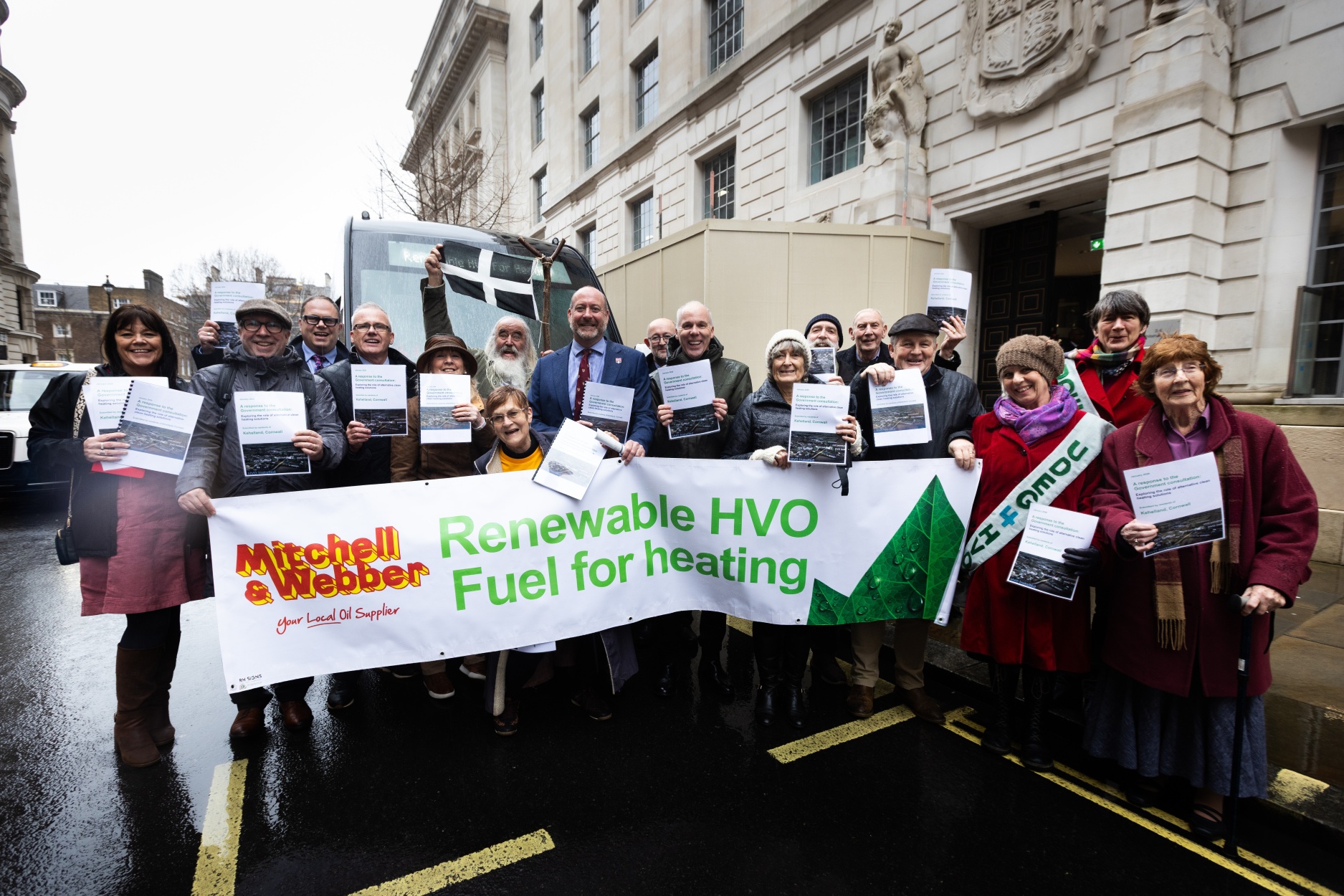
Towards the end of January, I joined members of a rural Cornish community on an important journey to Westminster.
The group was travelling to the Department for Energy Security and Net Zero (DESNZ) to submit the findings of a five-year, community-led trial of hydrotreated vegetable oil (HVO) in domestic heating, calling for its formal recognition within the UK’s rural heat decarbonisation strategy.
Presenting its evidence on the day the Government unveiled its long-awaited Warm Homes plan, the delegation from Kehelland urged policymakers to include practical, immediately deployable solutions for the UK’s 1.7 million off-grid homes.
Their message was clear: rural communities want to decarbonise, but must do so affordably, with minimal disruption, and urgently.
Over the past five years, Kehelland has become central to what is widely regarded as the UK’s most comprehensive community-led trial of HVO for domestic heating.
Residents initially explored electrification, but found the cost, disruption and technical challenges of converting older rural buildings to be prohibitive. Instead, the community partnered with local liquid fuel distributor Mitchell & Webber to trial switching existing oil boilers from fossil heating oil to HVO.
One participant was Kehelland Methodist Church, a multi-use community building. Andrew Geake, representing the church, said electrification was unsuitable due to the building’s intermittent use.
“We need heat on demand,” he explained. “Maintaining a constant temperature in a building used sporadically would waste energy and significantly increase running costs.”
The switch to HVO enabled the church to achieve substantial carbon reductions while retaining cost- and consumption-effective ‘heat on demand’.
Early success in Kehelland led to rapid expansion into a national trial supported by industry bodies OFTEC and UKIFDA. Running continuously for more than five years, the project has generated an unprecedented body of real-world data.
For many off-grid properties where electrification remains impractical in the short to medium term, the appeal of HVO lies in its ability to deliver immediate emissions reductions rather than waiting for more complex or costly upgrades to become viable.
Climate action groups United Downs Environment Group and Chacewater Energy Group also engaged with the project, recognising the role transitional fuels can play in delivering near-term carbon savings.
While MPs and select committee members have previously visited Kehelland, no minister from the Department for Energy Security and Net Zero (DESNZ) has yet done so. This prompted the decision to take the findings directly to Westminster.
“If DESNZ won’t come to Kehelland, we’ll take Kehelland to DESNZ,” said John Weedon, director at Mitchell & Webber and organiser of the “Cornwall March to Westminster”.
The delegation was met at DESNZ by representatives from OFTEC and UKIFDA, and by local MP Perran Moon, who described HVO as “a really sensible” decarbonisation option for rural communities, adding that it should be “part of the mix of different solutions”.
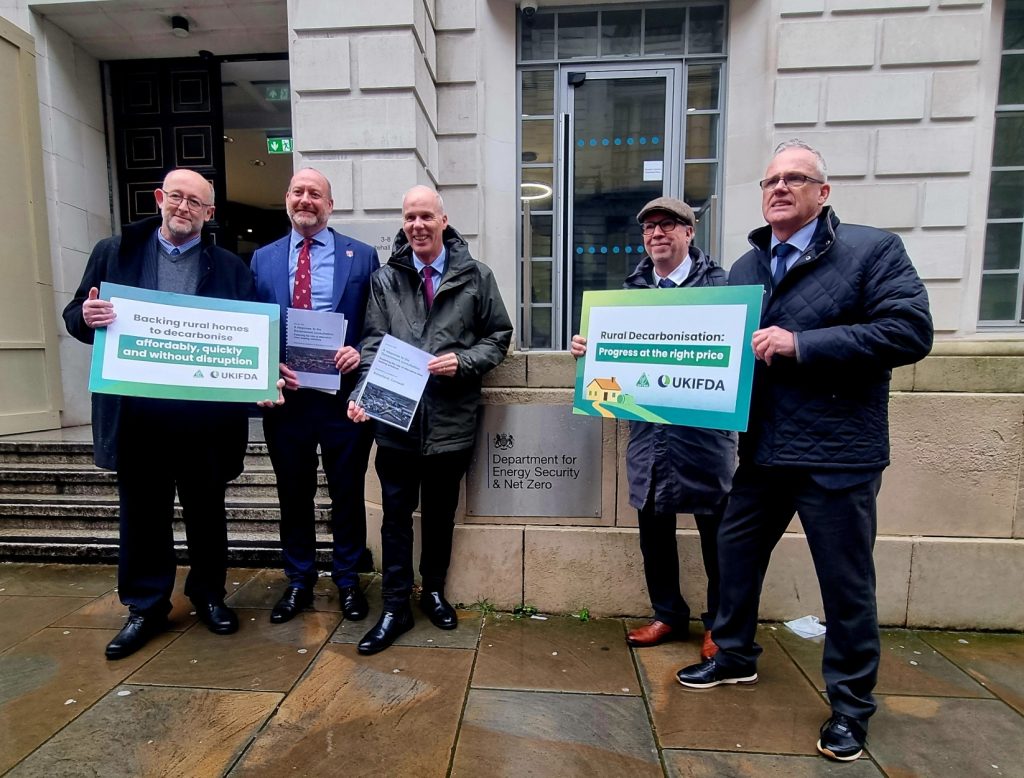
The findings were formally submitted to the Government’s consultation on Alternative Solutions for Rural Heat Decarbonisation, closing on 10 February – a decision point likely to shape heating policy for millions of off-grid households.
In a joint statement, industry bodies OFTEC and UKIFDA described the Kehelland project as “a remarkable success story”.
“It demonstrates that with the right solution, strong community partnership and clear communication, decarbonisation can begin with no upfront cost, no disruption, and only limited additional ongoing costs.”
As standard bearers for millions of off-grid fuel users,” the statement continued. “Rural communities such as Kehelland have shown what can be achieved if policy reflects on-the-ground realities.
The community believes the question is no longer whether HVO works, but whether rural and off-grid voices will be reflected in national decarbonisation policy.
As one resident commented during the journey to Westminster: “Five years of proven success – but it still feels like the Government isn’t listening.”
With the evidence now formally before policymakers, the hope within the fuel distribution sector is that practical, certified low-carbon liquid fuels already delivering results will be recognised as a credible part of the UK’s transition to net zero.
Concerns around the supply and sustainability of liquid biofuels remain important considerations – issues which the industry has already taken steps to address.
In order to ensure genuine sustainability, HVO supplied for heating in the UK is produced in accordance with the Renewable Transport Fuel Obligation (RTFO) sustainability framework, supported by recognised certification schemes such as ISCC. These require full traceability of feedstocks, robust lifecycle emissions accounting and controls on land-use change.
As a result, UK-certified HVO is derived from verified waste and residue feedstocks and excludes palm oil and palm oil mill effluent (POME), which is regarded as high-risk and is not permitted within RTFO-compliant supply chains.
Margaret Major, Managing Editor, Oil Installer
Images taken by M&W and Margaret Major